All The Unique and Affordable Filipino Décor You Can Find Around The Country
These proudly Pinoy products are beautiful enough to be put on your holiday shopping list!

Are you already thinking of what to give your friends this Christmas? Or are you stumped over what to gift someone who has everything?
Travel souvenirs make excellent gifts, especially those that speak about one’s experience with different cultures and the adventures in meeting a local woodcarver, a basket maker, a potter, or a weaver who makes handcrafted objects that are not commonly found in malls and commercial centers.
Folk arts and indigenous crafts are basic home pieces that can be both functional and decorative. They take a lot of time and patience to make, and the process of creating them is usually passed down from one generation to another. Buying these locally made products not only provides livelihood to creative communities, it also encourages the revival of traditional craft making and the preservation of our cultural heritage.
But what makes these handmade travel finds memorable gifts is the thought that they are meant to inspire others to travel and discover the culture and artistry of our regions. So the next time you go out of town, put some cultural adventure into your Christmas shopping:
1. Taka of Paete

Colorful, warm, and whimsical, the taka—or the painted animal figurines of Paete—are the epitome of Filipino folk art. These papier-mâché figurines of the popular red horses, roosters, carabao, and Filipiniana men and women are like a Filipino fiesta when grouped together. These takas are sold side by side with fine woodcarvings in shops this lakeshore town known for.
Price: P20 to P300, depending on size
Buhay at Hugis Paete, JV Quesada Street, Poblacion, Paete Laguna
READ: Go On A Cultural And Crafty Tour of Paete
2. Miniature Higantes of Angono

A bit of history: concerned with the loss revenue from fiestas, a stingy Spanish landlord banned all celebrations in the coastal town of Angono, except on the feast day of the town’s patron saint. As a form of protest, the townspeople created enormous and colorful effigies of their landlord and his family whose hands are high up on their waist. They fashioned the higantes’ (or giants’) heads from papier-mâché, while the bodies were made from bamboo sticks and yards of colorful clothing and staged the first Higantes Festival.

These days, you can buy your own higante, big or small, at Balaw-Balaw Folk Arts Museum as an Angono souvenir, and make perfect gifts, or can even be used as quirky holiday décor.
Price: P400 and up per pair
Balaw-balaw Restaurant and Folk Arts Museum, Doña Justa Street, Angono, Rizal
READ: 6 Places To Go To In Angono, Rizal, This Long Weekend
3. Moriones Mask of Marinduque

Sculpting wooden masks of Roman centurions with fierce facial expressions for the Moriones Festival is a year-round activity on the island of Marinduque. Masks are worn by during the staging of the Moriones as a life-long vow or panata. The Morion masks are now sought after souvenirs from Marinduque.
Dick Malapote who has been carving morion masks from fragrant santol wood since 1979, and receives orders locally and from other countries.
Prices: Polychromed masks complete with headdress can cost from P5,000 to 7,000 each, while plain wood masks sell for P1,500 to P2,000
Dick Malapote, Brgy. Janagdong, Mogpog, Marinduque
READ: There’s More To This Mysterious Island Than The Moriones Festival
4. Wood Filigree of Pakil
Pakil’s delicate art of wood shavings is admired both locally and internationally. Using a sharp-edged knife, the dexterous hands of the crafters whittle away soft wood, turning them into lacelike sculptures of flowers, butterflies, birds, peacocks, swans and fans that show intricate detail.
Conchita Mirabella has been practicing her unique skill of whittling wood since 1977. Some wood shavings are dyed, while others are left in their natural bleached wood shade. Conchita’s wood shavings have become popular as gift items, party favors, and as Christmas tree trimmings.
Conchita Mirabella, The Whittler Arts and Crafts of Pakil, 175 Tavera Street, Pakil, Laguna
5. Burnay Jars of Vigan

Burnayan is a potter’s village in Vigan, Ilocos Sur. Here, sticky clay dug out from the riverbanks is shaped by hand on a potter’s wheel, and fired in an open kiln to make the dark and heavy burnay jar. Old time potters claim that burnay is the first jar their ancestors ever made. Burnay jars are too thick to hold heat, so it was never used for cooking and since it is airtight water does not get cool enough to drink. Traditionally, the burnay jar was used for fermenting bagoong and the sukang Iloko. It is said that the sugar cane wine called the basi will not turn into a potent drink if it is not stored in a burnay jar.
Burnay jars are hardly ever used today for storing food and drinks, and are now used as keepsakes and décor. They have ended up in antique stores and the really old ones have been passed down as heirloom pieces.
Burnayan Liberation Blvd, Vigan City, Ilocos Sur
6. Embroidery from Lumban
In Lumban, Laguna, an old saying goes that embroidery is king and the womenfolk are the queens. Embroidery has thrived as a lively cottage industry in this lakeshore town for centuries. Ask any of the women embroiderers how this needlecraft was introduced, and nobody can give a definite history—only the craft has been passed on from mother to daughter for generations.
Lumban embroidery is equally sought-after like the French and Belgian lace for its intricate and delicate design patterns. Old time embroiderer, Lolita Lakbay-Rosales, revealed that it takes two weeks for her to embroider the size of a medium tambor, a round wooden stretcher where the piña fabric is stretched out as tight as a drum. Their products end up in high-end stores as well as in people’s market like Divisoria and Quiapo where price is tripled than buying it directly from embroiderers Lumban.
Lolita Lakbay-Rosales 18 Rizal St. Barangay Maracta, Lumban, Laguna (Editor’s Note: there are also Lumban embroidery products available in Metro Manila at Kultura Filipino)
7. Pandan Baskets in Luisiana
Sonia Apaya-Raculan, one of the old-time pandan weavers in Luisiana, Laguna explained that the manual labor of the pandan weavers consists of harvesting the pandan leaves, pressing, drying, and weaving them into traditional hats, flexible tampipis, and sturdy bayongs. It takes patience and dexterous hands to keep the multiple strips of dried pandan leaves into simple and tightly drawn together checkerboard weaves. Pandan products can be reused several times and can last a long time.
Sonia Apaya-Raculan Fabricante St., Poblacion, Luisiana, Laguna.
8. Abel Iloco
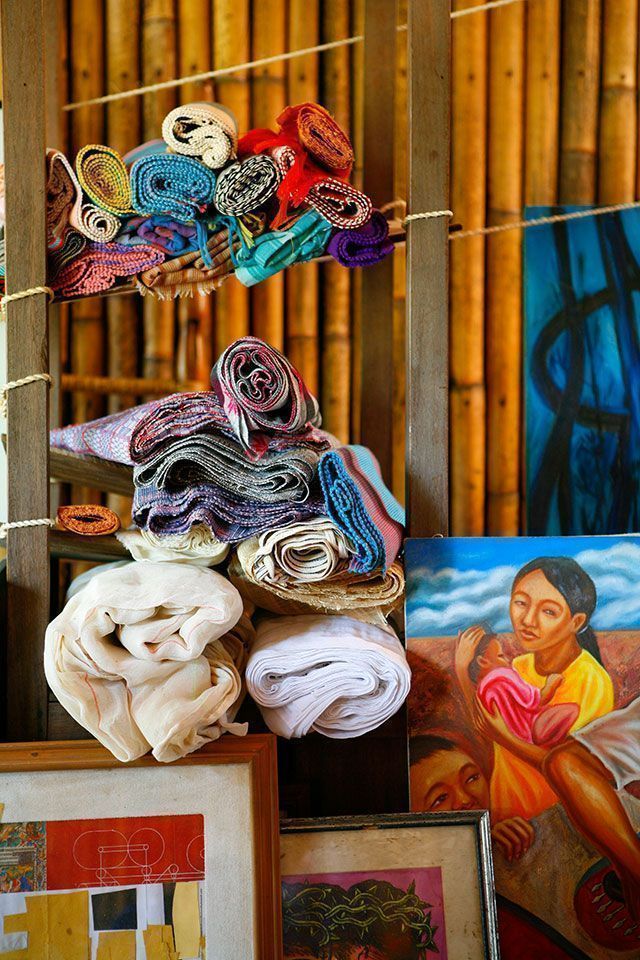
Abel is Ilocano verb for weave while inabel is a noun for woven fabric. This hand-woven fabric is colorful and can last for centuries as heirloom pieces in forms of clothing, blankets and decorative accessories. Weaving abel is a skill passed down from one generation to the next and takes years to master.
Woven patterns of the inabel were based from antique designs of blankets dating from the 1800s to the next century. Traditionally, inabel was used as blankets, clothing, and sails for galleons.
Price: A plain blanket costs around P400
Quitoriano Loom Weaving, Flores St., Naguilian, Caoayan, Ilocos Sur (Editor’s Note: You can also buy Inabel this coming weekend at the HABI Fair at the Glorietta Activity Center, from Oct. 12 to 14)
READ: Go On A Weaving Tour of Ilocos
9. Tinguian Weaves of Abra
At the Tinguian village of Namarabar in Abra, tribal elder Norma Mina Agaid retells the folk history of the Tinguian culture and traditions through her embroidery. In 1959, she embroidered on abel fabric the story of their folk myths and how Pinaing, the goddess of weaving who introduced through dreams the weaving patterns called the pinilian and binakol and the embroidery style called kinamay to the Tingguian women.
The same weaving styles and patterns are repeated today using indigo plant as a natural way of dyeing yarn and the long and painstaking process of backstrap weaving.
Norma Mina Agaid, Namarabar Village, Peñarrubia, Abra
10. Cordillera tribal baskets

Traditionally, baskets are must-haves in every Ifugao household. In Banaue, 92-year-old Ginnaymay Sarol can name every Ifugao basket there is. The akob is a round basket with a cover for carrying meals. A basket-tray used for winnowing rice is called ligao. Box -ike baskets are called the tupil and the hu-op. A traveler’s backpack called the pasiking. One variety has a shield made of tiered fibers called abnut. The inabnutan backpack is preferred by Ifugao hunters because it provides them protection from the rain.
Baskets make functional and storied gifts, plus they are light to carry when brought home as souvenirs or give aways.
Ginnamay Sarol, Poblacion, Ifugao, Banaue (Editor’s Note: You can also purchase some cordilleran baskets at PNKY, 2/F LRI Design Plaza, N. Garcia, Makati City)
11. Gourd Hat of Abra
Teofilo Garcia learned making takurong, the Ilocano for hat out of tabungaw or native gourd from his grandfather during his teens. The hat-making process begins from the planting of the seeds of the vegetable and knowing when it has grown into its right size for harvest, cutting in halves, drying and letting the ants eat the pulp to lining the edge with woven nito and weaving the built-in inner cushioning with alternating patterns using rattan and bamboo to make sure it snugs comfortably into the wearer’s head. In 2012, Apo Teofilo received the National Living Treasure award.
Teofilo Garcia, San Quintin, Abra
12. Wood carvings of Paete and Betis

In the towns of Paete, Laguna and Bacolor, Pampanga, the skill of carving wood to make religious statues and folksy sculptures were passed down from generations of woodcarvers. Woodcarvers learned the craft of woodcarving from apprenticeship. Paete woodcarvings are characterized for their neoclassical and Baroque tendencies, while woodcarvings from Bacolor have the Rococo design elements.

JV Quesada Street, Paete, Laguna, and shops along Gapan-Olongapo Road, Bacolor, Pampanga
READ: A Look At Pampanga’s Best Furniture Stores
Glenn Martinez is a heritage enthusiast and a travel blogger. Read more about his artistic and cultural adventures in his blog Traveler on Foot, or follow him on Instagram @traveleronfoot_gvm