What the Red and Orange NDRRMC Alerts Mean
We're sure you're familiar with those text messages, too

The continuous rain these past few days have brought severe flooding all over the country. Thousands were stranded, traffic's so bad, and many of us were stuck at home because of the inclement weather.
The effects of the Habagat have prompted the National Disaster Risk Reduction and Management Council (or NDRRMC) to send out alerts via SMS. And while there's a natural tendency to ignore these messages and just get back to your champorado-fueled Netflix binge, it does help to know what they mean. It's actually great to see the NDRRMC doing its job and keeping people posted—so the least we can do in appreciation is to understand their alerts and respond accordingly.
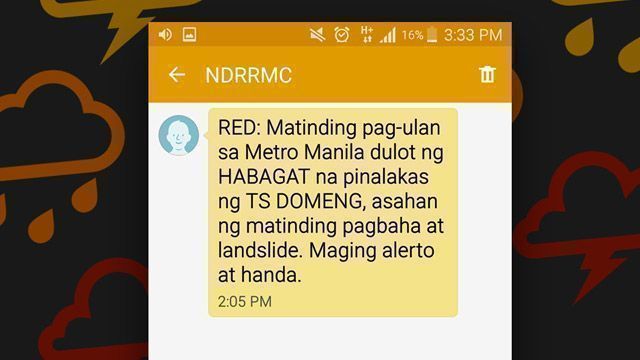
You'll notice that the NDRRMC sent out "RED" alerts last Saturday, explained as "Nagababadyang matinding pagbaha sa mababang lugar at malapit sa ilog."
Then yesterday, many received an "ORANGE" alert for residents of Metro Manila, Rizal, Pampanga, and Bulacan which states "Nagbabadyang pagbaha sa mababang lugar at malapit sa ilog."
So what do these color codes mean, exactly?
The NDRRMC alerts can be a complex as a whole, as there are different codes and levels for different types of disasters. Refer to this guide if you'd like to get acquainted with the entirety of it.
But this week's alerts ostensibly refer to the PAG-ASA Rainfall Advisory color codes. These are:
Yellow: 7.5 -15 mm rain observed in one hour and expected to continue in the next two hours. Flooding is possible in low-lying areas and near river channels.
Orange: 15-30 mm rain observed in one hour and expected to continue in the next two hours. Flooding is a threat in low-lying areas and near river channels.
Red: More than 30 mm rain observed in one hour and expected to continue in the next two hours. Serious flooding expected in low-lying areas. Take necessary precautionary measures.
There are several other codes and designations under the NDRRMC alert system, including ones for volcanic eruptions (alert level 3 and 4), earthquakes (intensity 6 and 7), and even armed conflict (crisis level 3 and 4). It helps to get familiar, and to always be prepared.
This story originally appeared on Esquiremag.ph.
* Minor edits have been made by the Realliving.com.ph editors.